Method
- Ripped both discs on the same drive: an OWC Mercury Pro, which is an LG BH16NS40 Blu-ray drive in an external case.
- XLD on macOS in Secure Ripper mode with AccurateRip lookup on and read offset correction set to +6, the community-verified value for that drive model. (Every drive design reads a few samples early or late, so the correction is specific for this model)
- Both rips finished with zero read errors, zero retries and zero damaged sectors.
- Spek was used to create and analyze the visual spectrograms
- Audacity used to analyze the waveforms sample by sample, as well as generate the audio clips
dr14meteris an open-source command-line tool used to compute the dynamic range (DR) of the music files
Because both discs went through the same drive, settings and tools, the only variable is the disc itself. That means any difference comes from the discs, not my setup.
Finding 1The bootleg is not a clone of the original CD
XLD checks every rip against AccurateRip, a global database of CD rip checksums. If your checksums match what other people got from the same pressing, your copy is verified bit-perfect.
My tUMULt rip verified on all five tracks with confidence 15 to 17, meaning that many other submitted rips of this pressing match mine exactly. My copy is the real 2000 master.
Original tUMULt CD, XLD log
AccurateRip Summary (DiscID: 000f4b7a-00481f26-4911da05)
    Track 01 : OK (v1+v2, confidence 17/39)
    Track 02 : OK (v1+v2, confidence 17/39)
    Track 03 : OK (v1+v2, confidence 17/39)
    Track 04 : OK (v1+v2, confidence 17/39)
    Track 05 : OK (v1+v2, confidence 15/37)
        ->All tracks accurately ripped.

ASRAR bootleg, XLD log
AccurateRip Summary
    Disc not found in AccurateRip DB.
The ASRAR disc is not in AccurateRip at all. It has a different table of contents, every track boundary sits at a different sector, and all five CRC32 checksums differ from the original.
| Track | Original CRC32 | ASRAR CRC32 | Match |
|---|---|---|---|
| 1 | 74EF605E | F296C17E | No |
| 2 | 8AE50EF7 | CA42A668 | No |
| 3 | DE8D1CA9 | EA4E9F67 | No |
| 4 | 16048936 | 9362DC2B | No |
| 5 | DD52D968 | 2382CAD5 | No |
To be clear about what this proves: absence from the database does not mean a disc is bad per se. A brand new legitimate pressing would not be in there either, and I scanned this the week it came out. But it does mean the disc cannot be verified, and the differing checksums prove it is not a bit-for-bit copy of this pressing. What it was made from is exactly what we're going to find out.
Finding 2The source is lossy
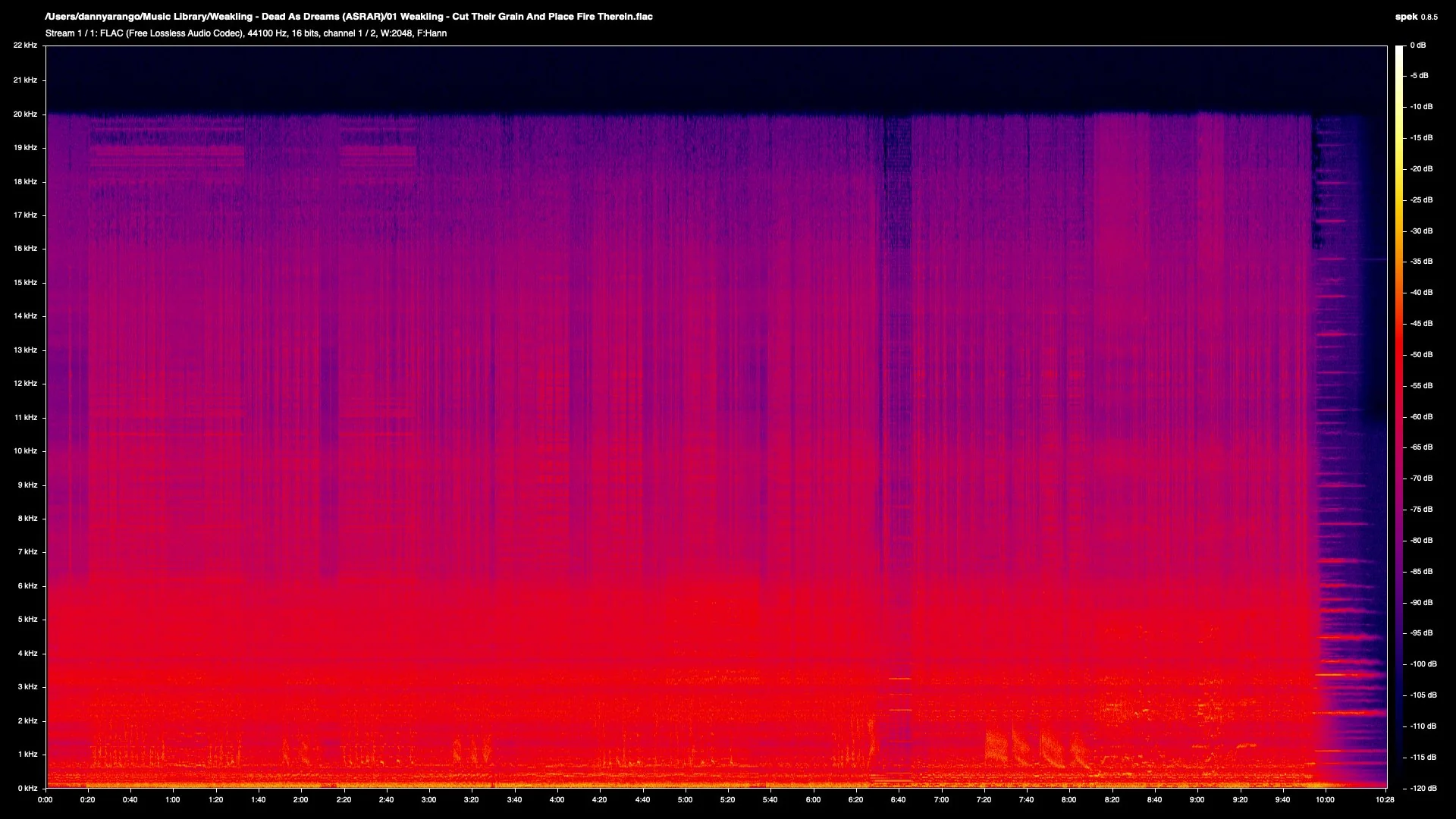
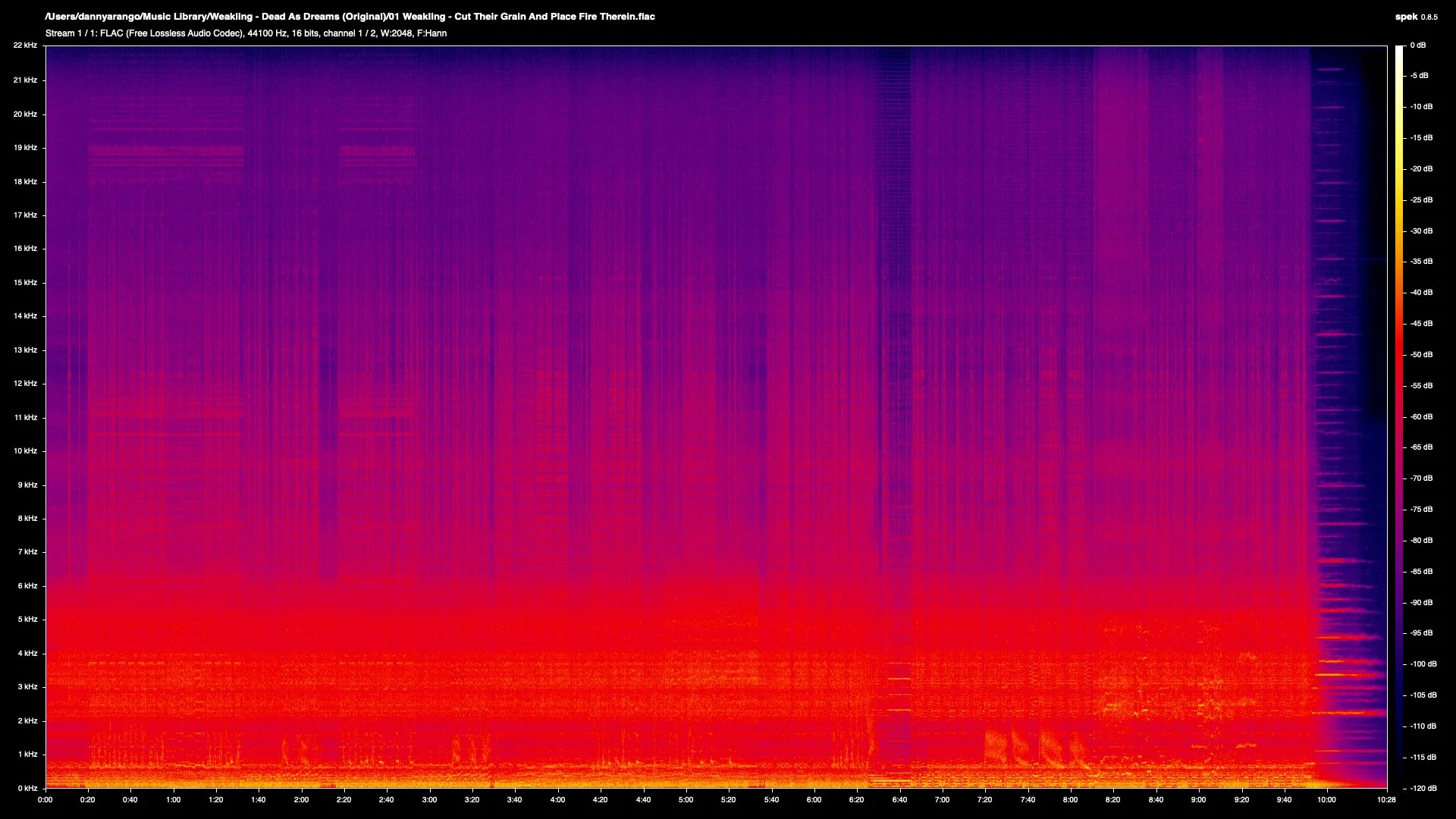
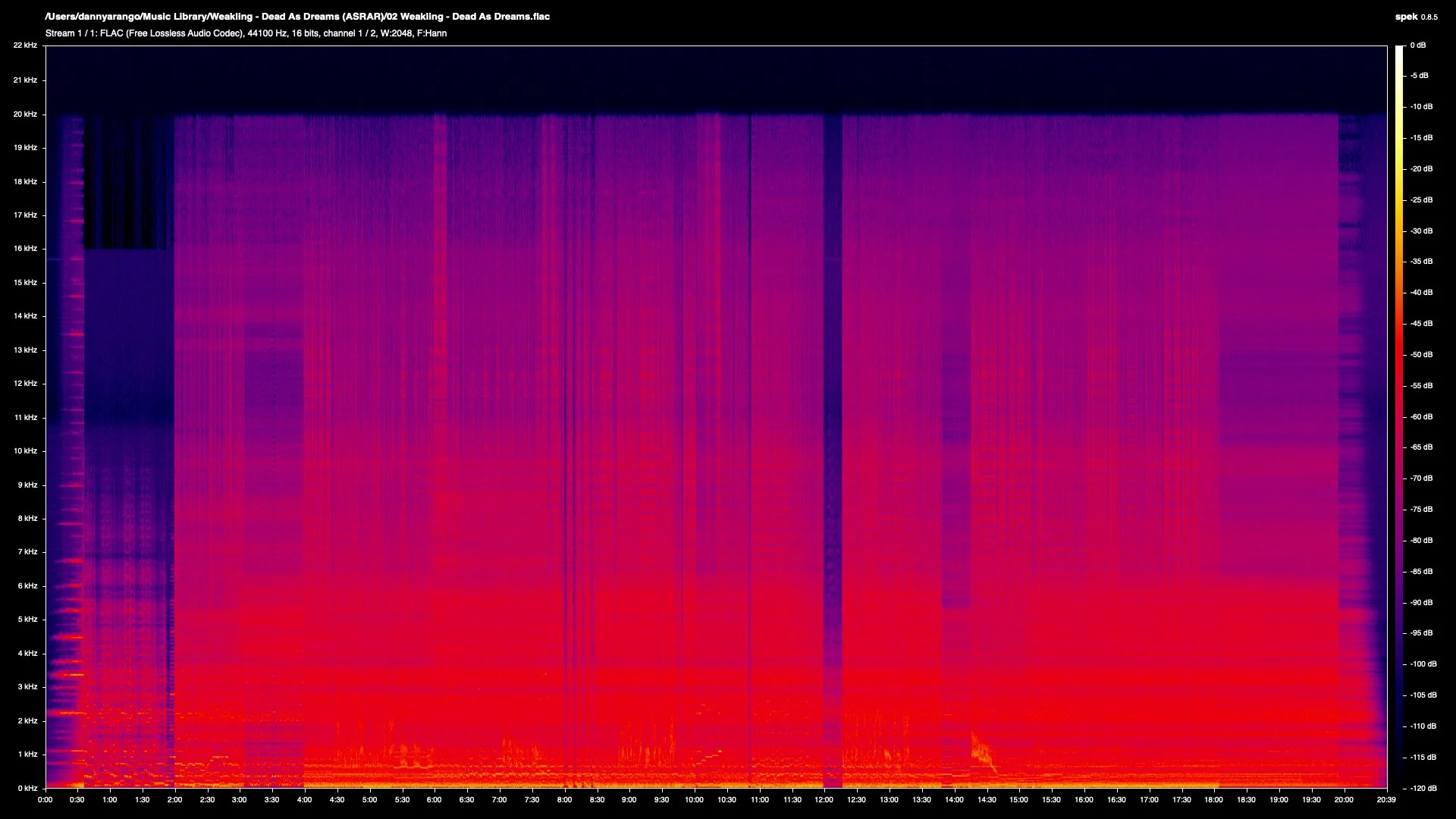
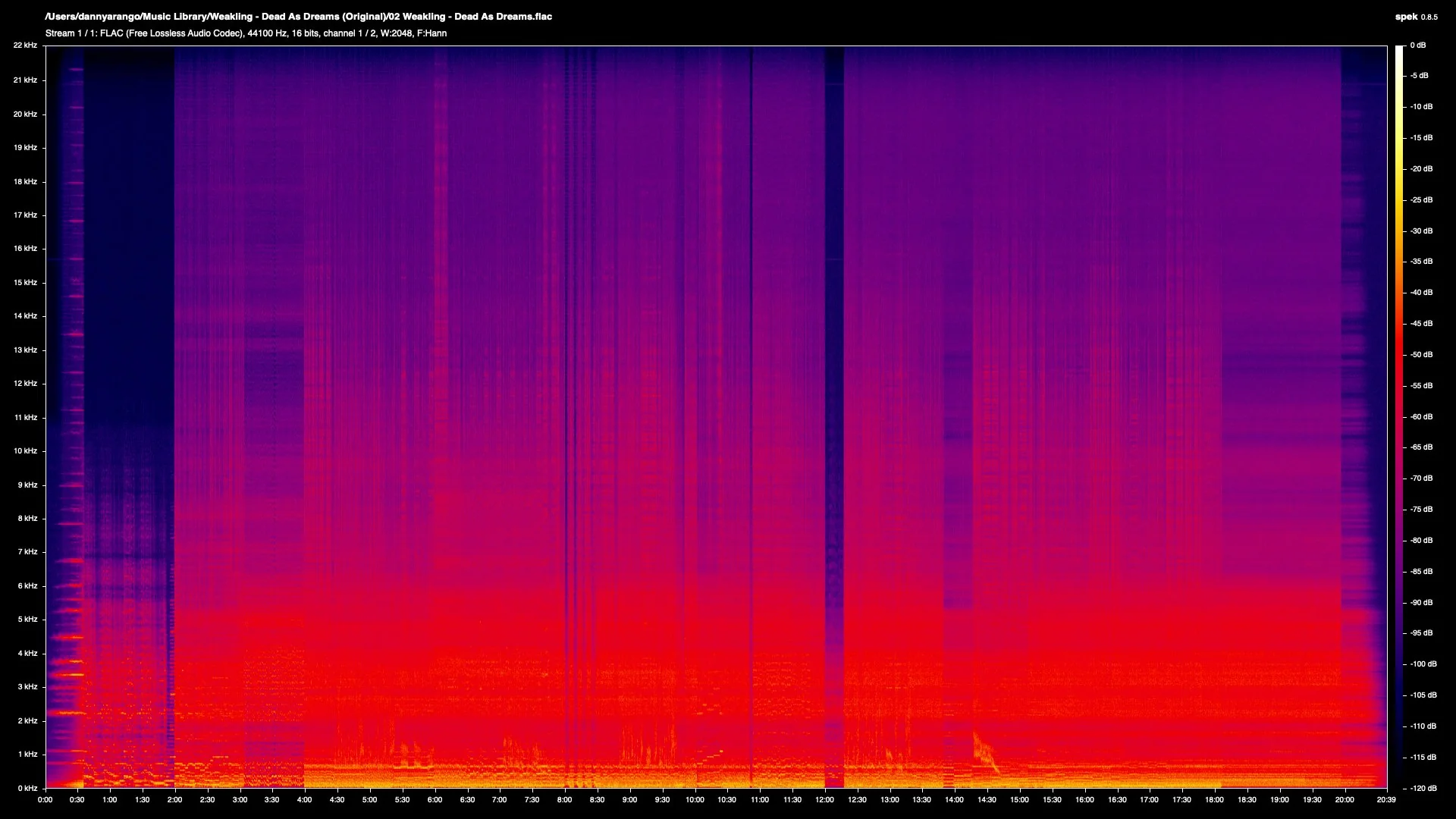
These are spectrograms from Spek: time runs left to right, frequency bottom to top, brightness is loudness. The original runs full bandwidth, with content past 21 kHz that fades out naturally. The ASRAR disc has a hard, straight wall at 20 kHz with nothing above it. On all five tracks.
 Original tUMULt CDASRAR bootleg
A flat ceiling like that is the signature of a lossy perceptual codec: MP3 or something similar. A 20 kHz wall is consistent with a high-bitrate encode, in the 256 to 320 kbps range. The disc itself is ordinary CD audio, so while the container is technically lossless, what it preserves is audio that was already degraded.
There is a second marker. In sparse, quiet passages the bootleg's ceiling drops to roughly 16 kHz, then snaps back to 20 kHz when the full band comes in. That is an encoder rationing bits in real time and spending fewer on quiet material. A real master's bandwidth does not breathe with the arrangement. It shows in at least three places: the intro of track 2 (about 0:30 to 2:00, the clearest example), the middle of track 4 (about 9:30 to 10:20) and late in track 5 (about 14:30 to 15:50).
Lossy damage is permanent, so no mastering restores information the codec threw away. Whatever “work” went into this edition happened downstream of a degraded source.
But we can see that is the same recording and the same master lineage, not a remix or an alternate transfer. The original has faint horizontal artifact bands around 19 kHz at specific moments, and the bootleg has the same bands at the same timestamps. Birthmarks of the master, inherited.
These visuals rule out a cassette source. While we can easily see the compression of ASRAR's version, analog rolloff is a gradual slope, not a straight wall. Not to mention, tape hiss would lift the noise floor, and the bootleg's quiet passages are as black as the original's.
Finding 3Was this copied from the original cassette?
The album did originally come out on tape in an edition of 300, so it's worth checking to see if we can rule that out. I loaded both versions of track 3 into Audacity and aligned them sample by sample. They lock from the opening transient to the tail more than fourteen minutes later, with zero drift.
When we align the sine waves bit by bit, you can really see how ASRAR's version is far more compressed than the original. The peaks and dips are higher and lower respectively on tUMULt's sound waves. This further removes the idea that the audio might've come from an original cassette source, since a sample-accurate lock over fourteen minutes cannot survive tape wow and flutter. This audio never left the digital domain.
Finding 4It was processed, and the DR number is a trap
The original is a hot 2000-era master with peaks essentially at 0 dBFS (decibels relative to full scale). All 5 ASRAR tracks peak at exactly -1.00 dB. That is the fingerprint of uniform peak normalization and proves someone processed this audio before authoring the disc.
You may have noticed that the bootleg's spectrograms look dimmer, most noticeable with the yellow highlights along the bottom. That is the level difference made visible. The bootleg is about 3.7 dB quieter on average, so everything sits a little lower on Spek's color scale. It is not missing bass so much as you would have to turn it up higher to get the same low-end detail.
Measured with dr14meter, the original comes out at DR6 (one track at DR7) and the ASRAR disc at DR9 across the board.
| Track | Original tUMULt CD | ASRAR bootleg | ||||
|---|---|---|---|---|---|---|
| DR | Peak dB | RMS dB | DR | Peak dB | RMS dB | |
| 1. Cut Their Grain and Place Fire Therein | 6 | -0.09 | -7.76 | 9 | -1.00 | -11.47 |
| 2. Dead as Dreams | 6 | -0.04 | -8.77 | 9 | -1.00 | -12.51 |
| 3. This Entire Fucking Battlefield | 6 | -0.00 | -7.78 | 9 | -1.00 | -11.56 |
| 4. No One Can Be Called as a Man While He'll Die | 7 | -0.00 | -8.49 | 9 | -1.00 | -11.91 |
| 5. Desasters in the Sun | 6 | -0.00 | -7.45 | 9 | -1.00 | -11.51 |
| Official DR value | 6 | 9 | ||||
Initially, this might make the bootleg seem more dynamic. But DR (Dynamic Range) is a ratio of the gap between the tallest peaks and the average loudness. Lossy encoding reshapes the waveform and leaves peaks slightly taller relative to the body of the music. It sharpens the spikes without adding any real light or shade. Normalizing that altered waveform makes the measured gap wider, so the number goes up.
This doesn't mean that the music got more dynamic. The measurement was simply “fooled” by the above phenomenon.
Finding 5The authoring is sloppy, and you can hear it
The real album is gapless which means that the tracks flow into each other. On the ASRAR disc there is an audible stutter at the seam between tracks 3 and 4. The waveform shows why. Track 3 on the bootleg ends on a hard vertical cut in the middle of a decay, at 14:44 against the original's 14:47, and track 4 slams in cold with the very tail end of that decay.
Hear it yourself
Here's the same transition on both discs, about five seconds each. The clips are lossless FLAC cut straight from my rips, so nothing was added or lost on the way to this page.
In the waveforms, the track boundary is the vertical line in the middle. The original runs straight through it. The bootleg stops early, sits silent, then restarts.
What you will hear is the cut, but if you're paying attention, even in these snippets, to my ears, you can hear the compression of the audio on ASRAR's version and how much more open and full the original's audio is.
The total audio on the two discs is virtually identical in length: 342,789 against 342,792 sectors, a difference of three sectors or about a twenty-fifth of a second. Yet about three seconds of music are gone from the end of track 3. This means that track boundaries were redrawn in the wrong places, some tracks longer and some shorter, with a glitch left at the seam. So the album was not just divided poorly. Music was cut, and dead air was added to make up the time.
Finding 6Even the packaging is wrong
The tracklist printed on the digipak does not match what is on the disc. The disc plays in the correct CD order, while the printed list shows what I can only assume is the vinyl track listing.
The LP edition sequences the album differently, presumably to get the tracks to fit properly across the sides of the double LP. So No One Can Be Called as a Man While He'll Die
ends up opening the album, and the rest of the track list remains the same. The vinyl layout clearly has been reused for the CD packaging, and nobody thought to check before printing it.
No One Can Be Called as a Man While He'll Die, which is track 4 on the disc inside.
Verdict
Very well made fan-club edition. Great mastering.
The discs show four failures in four separate layers.
- A lossy source: MP3 or a similar codec
- Blanket peak normalization to -1.00 dB
- Track boundaries redrawn, with music cut and an audible gap left at the seam
- A printed tracklist that does not match the disc
I came into this with no assumptions, other than hearing right away that something was off compared with the original. Sadly, and as many had already assumed, the evidence does not support the marketing.
The bootleg aligns sample-accurately with the real master, but it is not a lossless presentation of it. It was most likely made from an MP3 or a similar lossy file.
A full video breakdown with all of this on screen is in the works on CrateDigger. I'm happy to share the full logs or walk through any step so you can reproduce it.